
26 September 2020
Prague 1 and the advantages of the city district in the centre.
Do you wake up in the morning feeling the need for a change? Do you want to move right into the centre? And what is actually stopping you? In today's article, you will find out more about a Prague city district – Prague 1. Each individual part has its own charm and advantages that will captivate you.

In the previous article we introduced several city districts; today is dedicated to the heart of central Prague.
How do we find out whether something is right for us? We select, compare, and weigh the pros and cons. If you live and breathe medieval history and love being surrounded by historic buildings, this article is tailor-made for you. We will introduce the oldest Prague district – full of opportunities and right in the heart of the capital. We are talking about the beautiful part of the city that is Prague 1. The area includes Staré Město (Old Town), Josefov, Hradčany, Malá Strana, Vinohrady as well as Nové Město (New Town) or Holešovice. Cobbled streets, fortified courtyards, cathedrals, church towers. Everything within reach, everything for you. The district thrives on energy, music, the arts, rich food and special events, and in today's article we will introduce several of its advantages.

From the 14th century it began to be inhabited by the Prague elite – consisting of nobility, officials, philosophers and scientists. The atmosphere of history in this part of town is almost tangible. You are surrounded by architectural gems of past centuries. Social life took place on Old Town Square, and the Church of Our Lady before Týn complemented the space with its Gothic perfection. The interior of this sacred building was remodelled into the Baroque style during the 17th century. The place offers religious services as well as the possibility of visits. The atmosphere of the district is created by the Old Town Hall with its astronomical clock, on which 12 apostles appear every hour.
The area is significant for tourism. Among the notable buildings we will find the Church of St Nicholas, a magnificent Baroque structure whose interior is enriched by a chandelier with crystal glass decoration – a gift from the Russian tsar. The Powder Tower is a characteristic feature and was once the gate through which people entered the city (it also served as a gunpowder store). Finally, we must not leave out the Art Nouveau building – the Municipal House, a masterpiece of craftsmanship in the spotlight of the Old Town. Inside you will find a café, restaurants, a bar, a lounge and the well-known concert hall – Smetana Hall. The interior is decorated with the creativity of fine artists such as Alfons Mucha or Ladislav Šaloun.
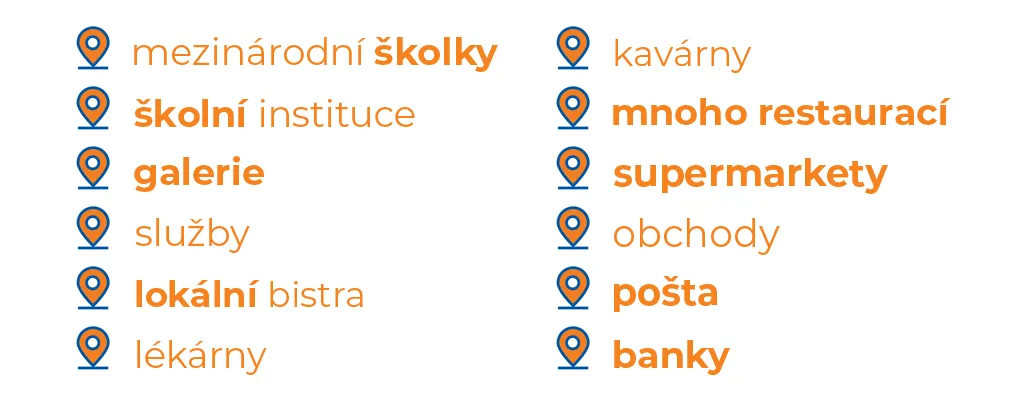
We recommend this area to people who crave history and want to breathe in the true magic of the old capital. It is also suitable for larger families and busy students. You will find comprehensive transport links and local amenities here –
We see the prestigious Old Town district as an ideal investment opportunity in the field of rental apartments. The properties can also be used for residential living, as well as for commercial purposes, i.e. for a company's registered office or for notary and law offices.

From here it is a stone's throw to practically any part of the city centre. A few minutes' walk will take you wherever you wish. Josefov was once a Jewish town, but the main Jewish monuments were left in place and stand here to this day. Preserved are six Jewish synagogues, the statue of Moses, the Old Jewish Cemetery and the Jewish Town Hall. Around the 16th century, the Jewish community in Prague was even the largest in Europe. Here you can admire the Old New Synagogue, the oldest surviving house of prayer in Central Europe.
The well-known name Franz Kafka is associated with the Josefov area. He was a novelist and short-story writer. His memorial – the Franz Kafka Monument – stands on the border between the Old Town and Josefov. This bronze statue depicts a headless man on whose shoulders the famous writer sits. The sculpture is inspired by a work from Kafka's writings – _Description of a Struggle._
Nearby, in Dušní Street (where Franz Kafka lived at one time), stands the Spanish Synagogue, which is the youngest and is currently managed by the Jewish Museum in Prague. It has barrier-free access. The vestibule of the building offers a ticket office, a museum shop and toilets. The programme consists of regular services, celebrations of Jewish holidays and significant days, regular chamber music concerts and other cultural events. The space is currently closed due to modernisation. In the district you can visit the Franz Kafka Bookshop, located on Široká Street (between Maiselova and Pařížská streets).

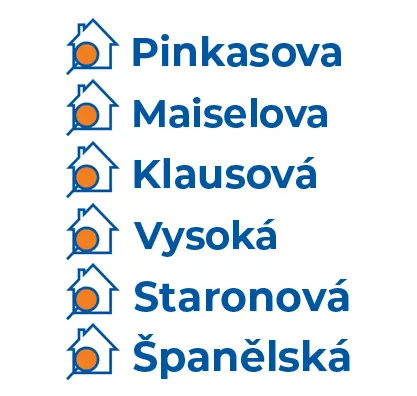
Josefov radiates a touch of historical life, together with a symbol of luxury and the present day. The area contains the best-preserved group of Jewish monuments in Europe. It is named after Joseph II, the son of Maria Theresa, and offers a wide range of local amenities and transport links. We recommend living here to families, working individuals, enthusiasts of history and culture, or investors who are looking for attractive investment opportunities.

Want to go to the castle? You can. This area is dominated by Prague Castle, with a dazzling view of the city. Here you will find the Gothic St Vitus Cathedral (made up of three naves and a rich system of buttresses with a high chancel), or the Basilica of St George, one of the oldest churches in the Czech Republic. You will also discover a Baroque riding hall, located in the wider castle grounds. The well-known Golden Lane offers colourful little houses with historical exhibits and souvenir shops. Most of the district consists of noble historic palaces and there are many other attractions you can enjoy: _romantic nooks, quiet places and beautiful viewpoints._ Hradčany was a separate municipal district until 1784, when it became part of the unified royal capital city of Prague.
A beautiful part is Hradčanské náměstí, which you can reach from several directions – from Prague Castle (east), via the Zámecké schody (south), via Ke hradu street (south), via the Radnické schody (south), via Loretánská street (west), and via Kanovnická street (west).
The Zámecké schody connect Thunovská street (Malá Strana) with the Hradní rampa (Hradčanské náměstí). The Radnické schody link the junction of the streets Ke hradu, Nerudova and Úvoz (Malá Strana) with Loretánská street and Hradčanské náměstí (Hradčany).
The Baroque building of the Archbishop's Palace, from the 17th century, is the seat of the Archbishops of Prague and stands on Hradčanské náměstí - near the castle gate. The square is also adorned by the Renaissance Martinic Palace, consisting of four wings and a main façade (facing the square, with one side wing located on Kanovnická street).
The area is enriched by various restaurants, cafés and galleries (e.g. National Gallery Prague – Schwarzenberg Palace or National Gallery Prague – Salm Palace) and hotels. Hradčany is suitable for artistic souls, architecture lovers, families with children, couples and working people. It is an ideal place for family living or investment purposes.

The formal name of Malá Strana is the Lesser Town of Prague. The name of this historic district derives from its position on the left bank of the river [](https://www.vltava-reka.cz/ "Vltava")Vltava (west, the slopes below the castle), which denotes a smaller area than the larger districts of Prague on the right bank of the Vltava (connection: Charles Bridge).
One of the most charming districts is known for its hidden streets and cobbled squares, ancient churches and interesting landmarks or activities, and last but not least – cultural experiences.
Worth mentioning is the Church of St Nicholas, also nicknamed the cathedral of St Nicholas. It is a Baroque church located on Malostranské náměstí. The work is considered the most significant Baroque building in Prague. It earned this recognition thanks to its grandeur and its demanding artistic and architectural execution. The iconic green dome and bell tower lend the panorama of Prague a truly historic spirit. The church, which has hosted concerts by composers such as Bach or Mozart, simply ranks among the most beautiful architectural gems of the city.
Your visit will be rewarded by the Lennon Wall, surrounded by gardens and charming squares. It is made up of creative works, most of them always dedicated to the famous singer John Lennon and to lyrics by the Beatles. During the communist regime, groups of young people expressed their disagreement through contributions on the wall. Unfortunately, the original painting of Lennon is now lost beneath several layers.
We recommend Malá Strana to people who do not mind tourists. Everywhere can be reached comfortably by public transport, and this can be a privilege for you as well as for visitors to the capital.

The 40s of the 14th century. Europe was forever influenced by the urban planning project of Charles IV. The timeless Czech king, with the complexity and scale of his work, outdid any city foundation up to that time. Construction began very quickly and successfully. The bank of the Vltava, at the boundary of the Old Town and Vyšehrad, gave rise to Wenceslas Square, Charles Square, Senovážné Square and Republic Square. The New Town became part of Prague in 1784. It is shared by Prague 1 and Prague 2.
Streets typical of this area include Myslíkova, Vodičkova, Jindřišská, Dlážděná, Havlíčkova, Zlatnická, Žitná, Ječná (where we are located too), Politických Vězňů, Panská and Opletalova.
The historic space of Charles Square offers 80,552 m² and a main junction. In addition, you will find here a tram line, once trolleybuses - today buses and a station of metro line B. Charles Square falls under Prague 2 and historically belongs to the aforementioned New Town.
In the surrounding area you will also find Václavské náměstí, a key place for tourism and a very popular spot. "Václavák" is a famous space for demonstrations, celebrations, events and mass gatherings – of various kinds. Its dominant feature is the well-known equestrian statue of St Wenceslas. You will discover many restaurants, shops and famous hotels here.
The upper part is the busiest choice for pedestrian traffic - in the whole of the Czech Republic. By 2023, the upper section is due to see wider pavements, the planting of new avenues, a reduction in the number of parking spaces, a dedicated cycle lane, and changes to tram services. The main change is meant to be the proposed change to traffic routing - trams are to return to their original route. This time, however, it will not be through the middle of the square, but along its edges (the passage of cars). The centre of the square wants to be preserved as a quality space for the public.
We all have our own preferences that guide us – and that we insist on. At our real-estate agency, we believe that everyone can find their dream home in our wide range of properties. We always recommend that our clients think carefully about which part of the city they will feel most comfortable in. It is essential to determine whether the given district matches your expectations regarding transport accessibility, whether the area has sufficient amenities and services, and whether it has enough relevant schools or parks, or opportunities for development and entertainment.
We care about helping you make an effective decision.
Choose well, choose MAXXUS.